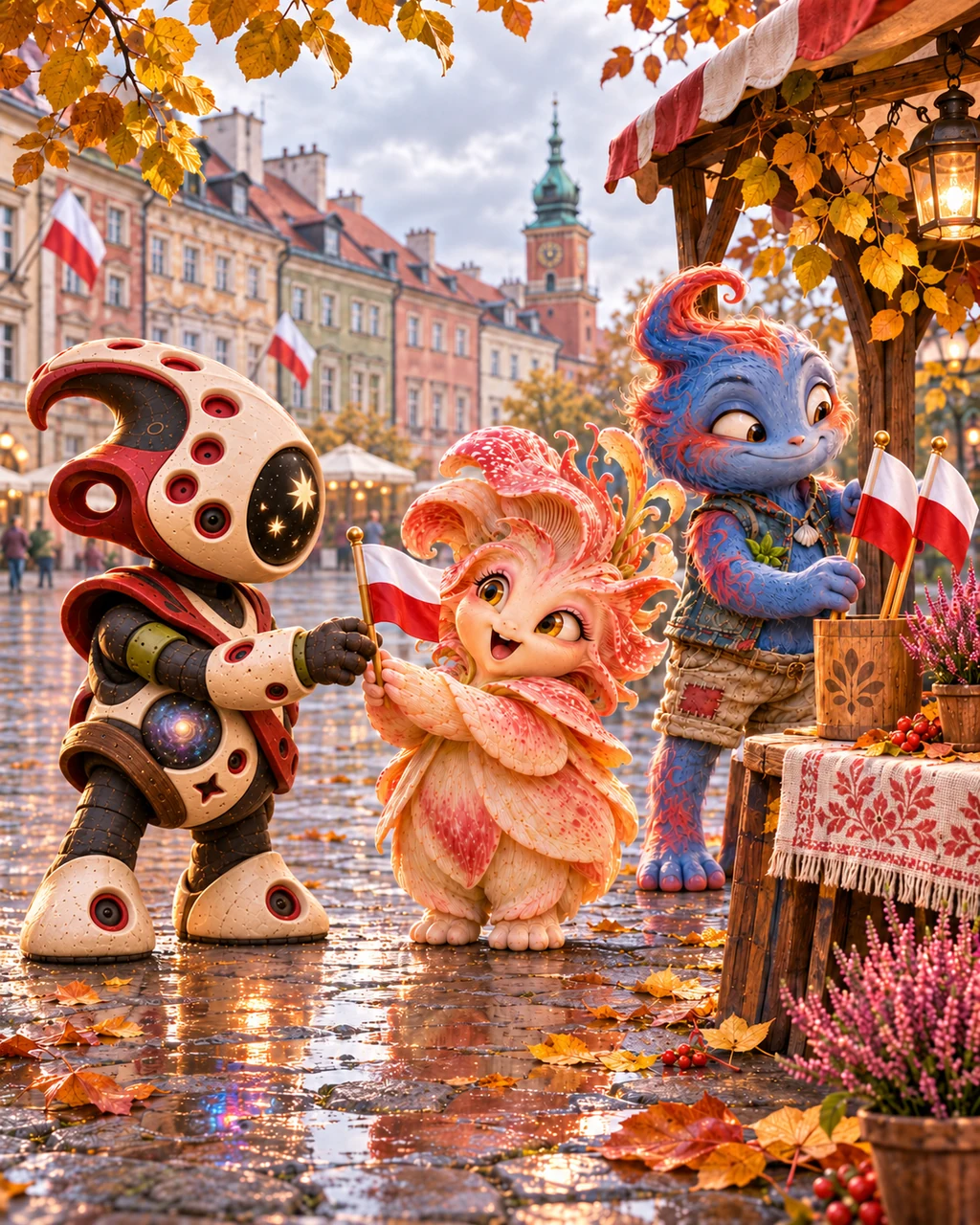
The Warsaw street smelled of wet leaves and chimney smoke. The Blue Current left the friends under a building’s awning. Its glowing sign showed the date: 10 November 1918.
A boy in a cap was running towards a door.
‘Mr Leon! Piłsudski’s back! He arrived in Warsaw this morning!’
A man in a stained apron peered out of a small printing shop.
‘From Magdeburg?’
The boy nodded vigorously.
‘That’s right!’
Orumi was about to run after him, but Nubo gently stopped him.
‘Let’s find out what’s happening first.’
The printer invited them inside. Józef Piłsudski, he explained, had been imprisoned by the German authorities in Magdeburg and had now returned to Warsaw. After the long war, great changes were taking place in Europe. Hope was growing that a Polish state would be reborn.
‘An independent state can decide its own affairs,’ he added. ‘For years, many people have worked towards a Poland like that.’
‘So will everything be ready tomorrow?’ Orumi asked.
Mr Leon looked at the scattered sheets.
‘We can’t even put this newspaper together in a single move. A state takes much more work.’
The boy introduced himself as Stefan. He helped his father at the printing shop and could not sit still today. He kept bringing news, but sometimes repeated rumours nobody had checked yet.
‘Apparently everything’s been settled already!’ he announced.
‘What exactly? And who told you?’ his father asked.
Stefan adjusted his cap. That was something he did not know.
Nubo looked in their travel notebook. There were still plenty of empty pages. He decided to write down only news they could confirm.
The Blue Current murmured softly. Evening fell outside, then the light changed to morning again. The passage had carried them one day forwards.
It was 11 November.
News reached the printing shop that the Regency Council had handed Piłsudski command of the Polish troops under its authority. Mr Leon explained that the Council was one of the existing governing bodies.
‘It’s an important step,’ he said. ‘But things are happening differently in different places. Common authorities still need to be established, the country’s life organised and people’s safety protected. The fighting hasn’t ended everywhere.’
Stefan stopped twisting his cap.
‘Can we be happy when there’s still so much left to do?’
Fira stood beside him.
‘You can be happy about something important and still have a lot of work ahead.’
People stopped in the street to talk and share news. White and red appeared in some windows. Nubo thought of Antek learning to read, and families listening to Polish songs. He remembered Paderewski’s concert.
A stack of blank sheets toppled over. Orumi crouched to gather them up. Stefan tried to grab them all at once, but Fira helped him make smaller piles.
‘Important things were happening in so many places,’ Nubo observed. ‘We can’t fit it all into one sentence.’
‘We can fit it into a story,’ Mr Leon replied. ‘We just have to tell it well.’
Back in their own time, they found a note in the atlas: ‘11 November — National Independence Day.’ Nubo wrote that it was a symbolic date marking the regaining of independence, reached through many events and the efforts of many people.
Orumi looked at the long entry.
‘So it wasn’t news for just one little slip of paper after all.’
‘That’s why we left so many empty pages,’ Nubo answered.
November leaves rustled outside. Fira waited for the ink to dry before closing the notebook.