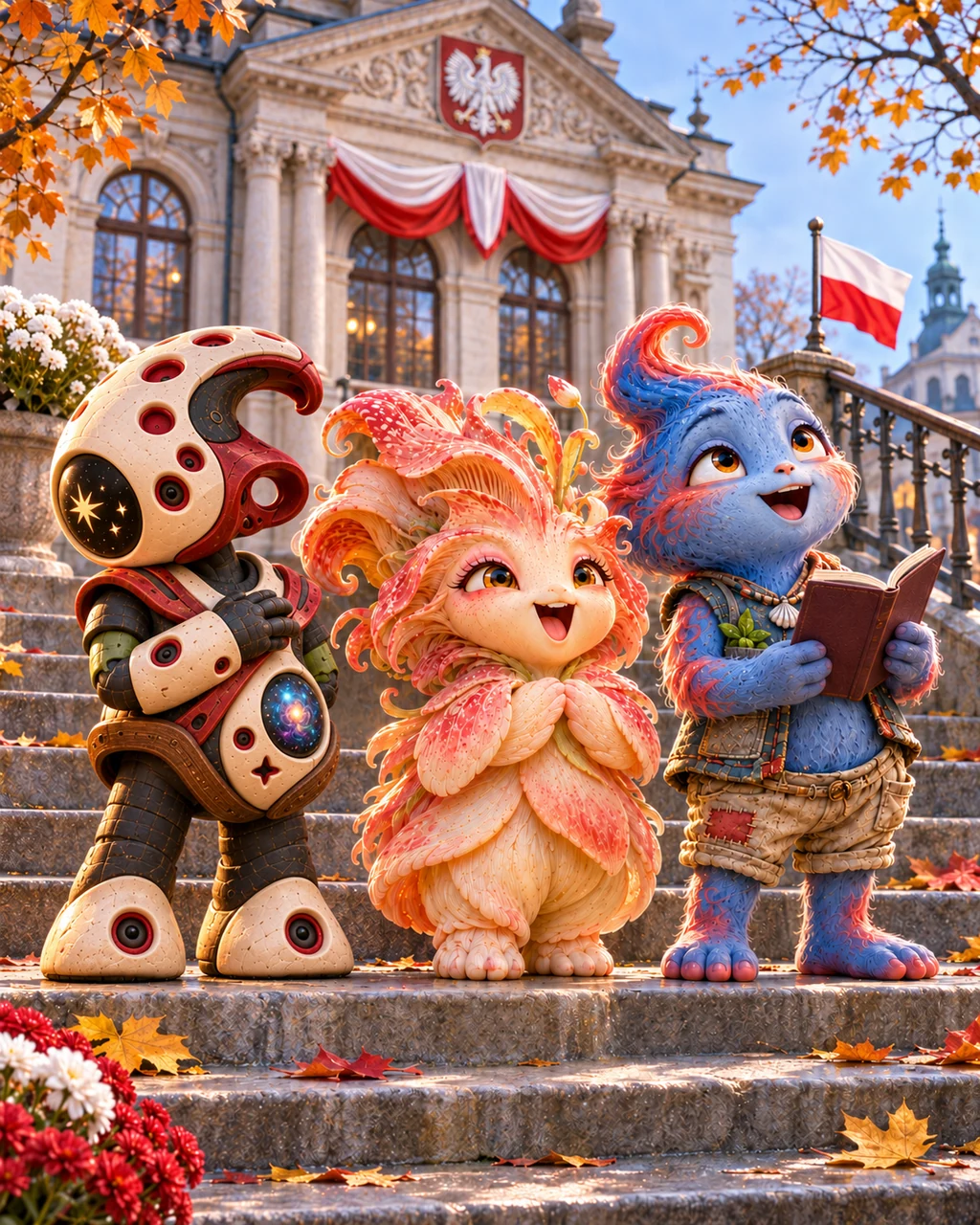
‘If Poland regained its independence, what happened afterwards?’ Orumi asked.
The Blue Current answered with a streak of light. Snow awaited them beyond the passage. Nubo almost immediately sank into a snowdrift, and Fira offered her hand.
It was 26 January 1919. The friends were in Warsaw again.
A queue stood outside a building. A woman adjusted the scarf of a girl trying to hide her nose from the cold.
‘Mum, do you really get a voice today?’ the girl asked.
Orumi stopped, curious.
‘I can hear that your mum has a voice. She was speaking a moment ago.’
The girl burst out laughing.
‘A different kind of voice! I’m Zosia. And this is my mum, Mrs Zofia.’
The woman explained that elections were being held for the Sejm, the parliament of reborn Poland. Adult citizens were choosing representatives who would work on the country’s laws.
‘Since 28 November last year, women have had the right to vote and stand for election,’ she added. ‘Many women worked for a long time to have a say in the country’s affairs. Now I can cast my vote too.’
Zosia squeezed her hand.
‘I can’t yet. Mum says I’m too young.’
‘But you can ask questions,’ Fira replied. ‘Thanks to you, we’ve learnt something too.’
The queue moved forwards. Orumi noticed a piece of paper by the wall and bent to pick it up.
‘A lost vote!’ he announced with concern.
Mrs Zofia looked at his find.
‘That’s a coal bill.’
Orumi examined both sides and took it to a nearby man. Luckily, its owner had been looking for it.
When Mrs Zofia’s turn came, the friends stayed with Zosia at the entrance. Nubo watched people going inside. There was no stage or grand orchestra. Shoes creaked, someone shook snow from a coat, someone made room for an older person.
‘Is this part of independence too?’ he asked quietly.
‘I think we’re watching people begin to shape their country together,’ Fira replied.
Zosia wished her school had more books. Nubo asked about her favourite story. She talked so much that she almost missed her mother coming back.
Mrs Zofia did not look different. She wore the same coat and slightly crooked hat. Yet Zosia hugged her as though she had returned from a very important adventure.
The Blue Current took them back. On the familiar street, it was November in their own time. Flags hung from buildings. A nearby school was rehearsing for its holiday celebration.
At the library entrance, a child gathered scattered books. Orumi glanced towards the square where the celebrations were about to begin, then crouched beside the books.
Nubo helped arrange them on a trolley. Fira held the door. They reached the square before everyone began singing the anthem, and stood quietly beside the other participants.
Later they visited an exhibition of old photographs. One showed a woman in a hat beside a girl in a thick scarf. They could not know whether they were Zofia and Zosia. Fira smiled all the same.
‘Now I know what happened afterwards,’ Orumi said. ‘Lots of ordinary days when people had important things to do.’
Nubo opened a fresh page. Under 11 November, he also wrote the library’s address. They had promised to come back and help with the next trolley of books, after all.