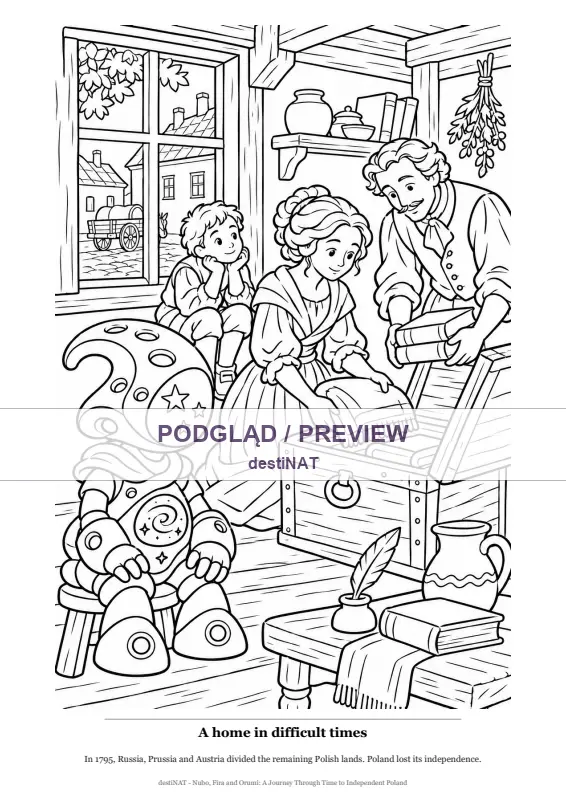
These stories combine the fictional adventures of destiNAT characters with a real historical background. Antek, his grandmother, Hania, the printer Leon, Stefan, Zofia and Zosia are fictional. The dialogue of Józef Wybicki and Ignacy Jan Paderewski is a literary invention, not quotation from documents. The concert is an imagined scene set during Paderewski’s actual relief work.
The third partition of the Polish–Lithuanian Commonwealth took place in 1795. In July 1797, Józef Wybicki wrote the Song of the Polish Legions in Italy, later known as Mazurek Dąbrowskiego. The exact day of its composition and first performance is uncertain, so the story gives no precise day.
During the First World War, Paderewski organised relief and supported Polish independence, including in the United States. Poland’s regaining of independence is not attributed to him alone.
Józef Piłsudski arrived in Warsaw on 10 November 1918. The next day, the Regency Council handed him military authority and supreme command of its Polish troops. Regaining independence was a process. The date 11 November symbolises it; it does not mark the settling of every border or the end of all fighting.
The decree of 28 November 1918 granted women voting rights in Poland. The first elections to the Constituent Sejm took place on 26 January 1919 in areas where they could then be held. The electoral law gave voting rights to citizens aged 21 and over regardless of sex, subject to its conditions and exclusions. The story depicts a fictional Warsaw family.
Materials for checking the historical background
- Polish Army Museum — The third partition of Poland
- Polish History Museum — The first performance of Mazurek Dąbrowskiego
- Music Schools Complex in Białystok — Biography of Ignacy Jan Paderewski
- Institute of National Remembrance — Polish paths to independence
- State Archives — The Regency Council’s appeal to the Polish nation
- National Archives in Kraków — Elections to the Constituent Sejm