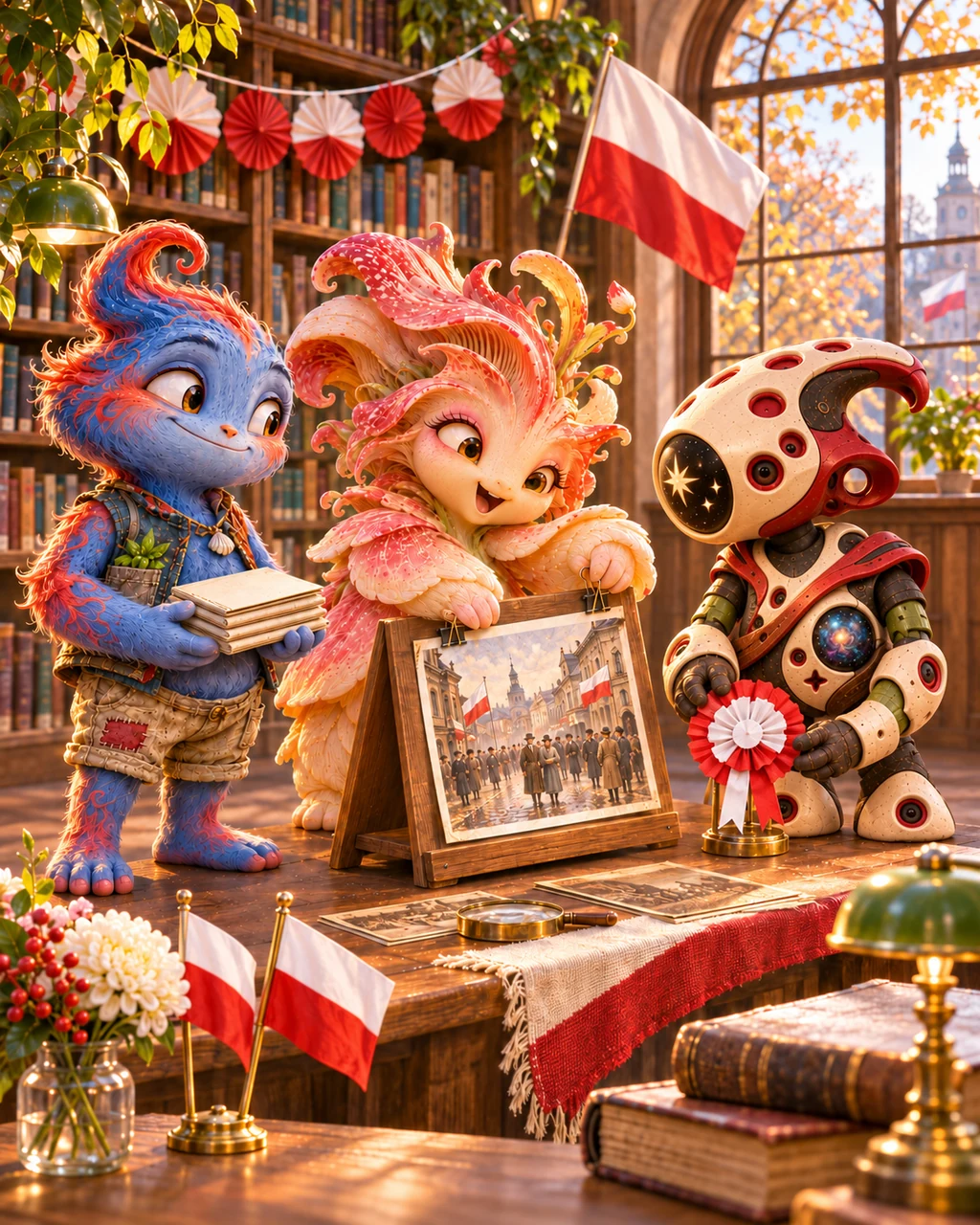
Nubo found a huge atlas in the library. He opened it on the table, and Orumi immediately pulled up a chair.
‘Are we looking for somewhere to go on our next adventure? Perhaps a place where pasta grows on trees?’
Fira smiled and held down the curling corner of a page. Nubo turned the pages more and more slowly. On one map, Poland was labelled. On the next, showing a later time, he could not find its name.
‘A country couldn’t just evaporate,’ he said.
Just then, a blue streak flashed between the pages. The Blue Current swept in a circle and opened a glowing passage before the friends.
A moment later, they stood outside a wooden house. A small sign projected by the Current showed a year: 1795.
Through the half-open door came the sound of someone slowly sounding out words. A boy sat at a table. An older woman pointed to the words in a book, one after another.
‘Excuse me,’ said Nubo. ‘Are these the Polish lands?’
‘Yes,’ the woman replied. ‘Come in. I’m Antek’s grandmother.’
Orumi looked out of the window. He saw an orchard, a road and a neighbour carrying a basket.
‘Everything’s still here! So why is Poland missing from the map?’
Grandmother put down the book.
‘Russia, Prussia and Austria have divided our lands between them. This year was the final partition. Poland lost its own independent state. Foreign authorities rule here now.’
The table fell quiet. Fira moved closer to Antek.
‘And you’re still reading in Polish.’
‘I’m learning,’ he replied. ‘Sometimes I get the letters muddled.’
‘I get roads muddled,’ Nubo admitted. ‘That’s no reason to stop travelling.’
Grandmother told them about families passing their language, songs and memories on to their children. People still lived in their homes, worked and remembered who they were. Having no state of their own had not wiped them from the earth.
Antek returned to his reading. Orumi was about to help with a difficult word, but Fira lightly touched his shoulder. They waited. The boy worked it out himself.
The Blue Current shimmered in the doorway again. This time the friends stepped onto a sunny street in Italy. It was July 1797.
Polish words drifted from a nearby room. A man sat at a table with a sheet of paper. Beside him stood Polish soldiers serving far from home.
‘That’s Józef Wybicki,’ one explained. ‘He’s writing a song for us.’
Fira looked at the lines he had written.
‘What’s it about?’
‘Poland. And the hope that we will be able to return there,’ Wybicki answered.
Someone took up the tune. Soon more voices joined in. Nubo listened carefully. He did not understand every word yet, but saw the singers straighten their backs and look at one another with great attention.
Back in the library, the friends looked up the song in a book. In time, it became Poland’s national anthem, known as Mazurek Dąbrowskiego.
Orumi reached for a pencil.
‘I’ll write Poland onto that map!’
Nubo gently closed the atlas.
‘That map shows who ruled at the time. Now we know what a map cannot show on its own.’
Fira opened their travel notebook. She drew a little house, a book and a few musical notes. Underneath, Nubo wrote: ‘People remembered.’ Orumi added Antek leaning over a difficult word. This time he was in no hurry to help.